
The Andromeda Galaxy
The Andromeda Galaxy is our nearest large galactic neighbor — 2.5 million light-years away, visible to the naked eye on a clear dark night, and on a slow collision course with the Milky Way.
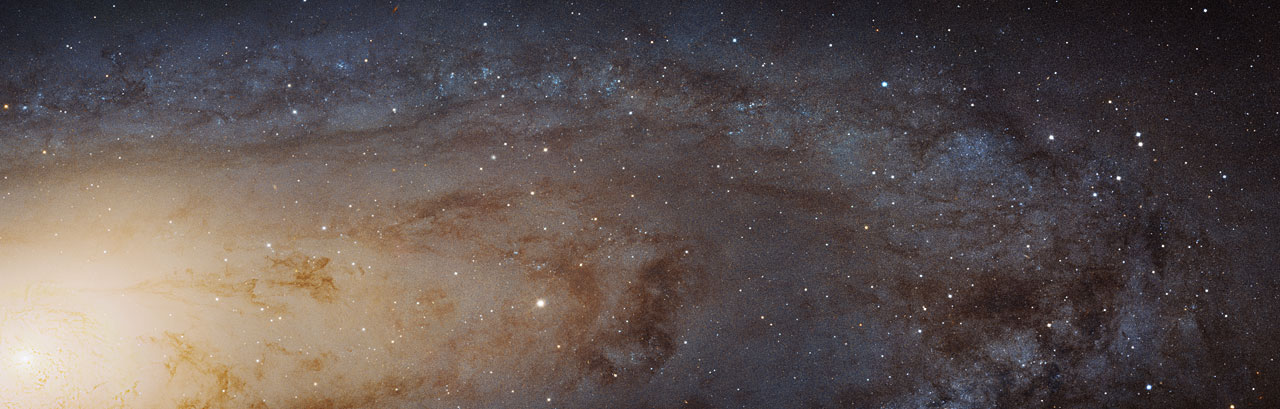
Image credit: NASA, ESA, J. Dalcanton, B.F. Williams, L.C. Johnson (University of Washington), the PHAT team, and R. Gendler. The Panchromatic Hubble Andromeda Treasury (PHAT) survey resolved over 100 million individual stars across M31's disk.
Also Known As
M31, Messier 31, NGC 224
Constellation
Andromeda
Object Type
Spiral galaxy
Best Viewing
Fall evenings in the Northern Hemisphere
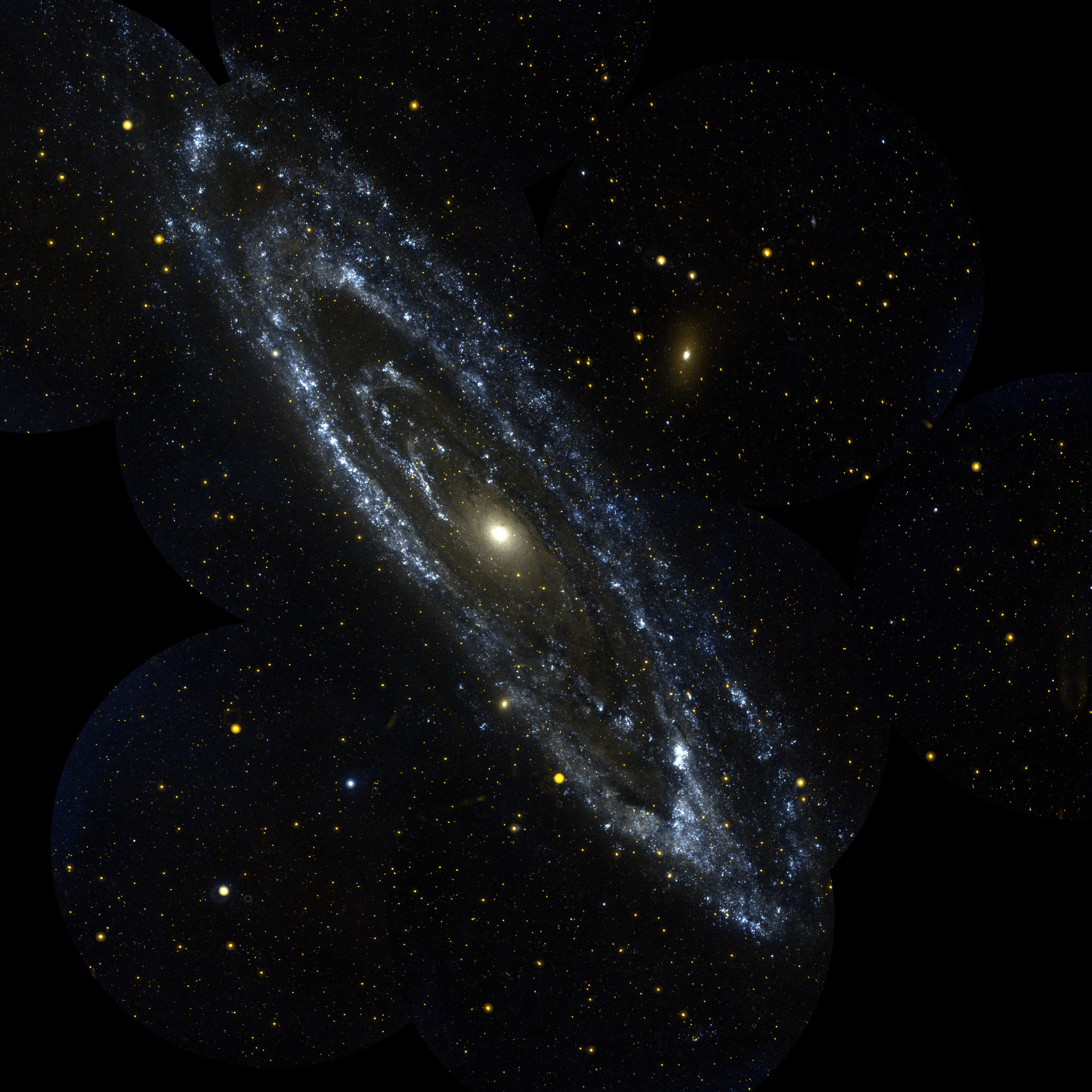
The nearest large galaxy — and the farthest thing you can see unaided
The Andromeda Galaxy is a spiral galaxy containing roughly a trillion stars. At 2.5 million light-years, it is the most distant object most people ever see without a telescope. On a clear, moonless night away from city lights, it appears as a faint elongated smudge — ghostly, subtle, and unmistakable once you know where to look. It is physically enormous in the sky: while its visible core looks small, the full extent of Andromeda spans more than six times the width of the full Moon.
It is also heading directly toward us. For decades, astronomers expected Andromeda and the Milky Way to collide in roughly 4.5 billion years — though a 2025 study now puts the odds of an eventual merger at about 50/50. If it happens, the word "collision" sounds violent, but space is mostly empty: individual stars would rarely crash into each other. What would happen is a slow gravitational dance lasting hundreds of millions of years, reshaping both galaxies into a single elliptical system astronomers sometimes call "Milkomeda."
Three views of M31
Hubble PHAT Panoramic
The Panchromatic Hubble Andromeda Treasury resolved over 100 million individual stars across a portion of M31's disk — the sharpest and most detailed view ever made of another galaxy.
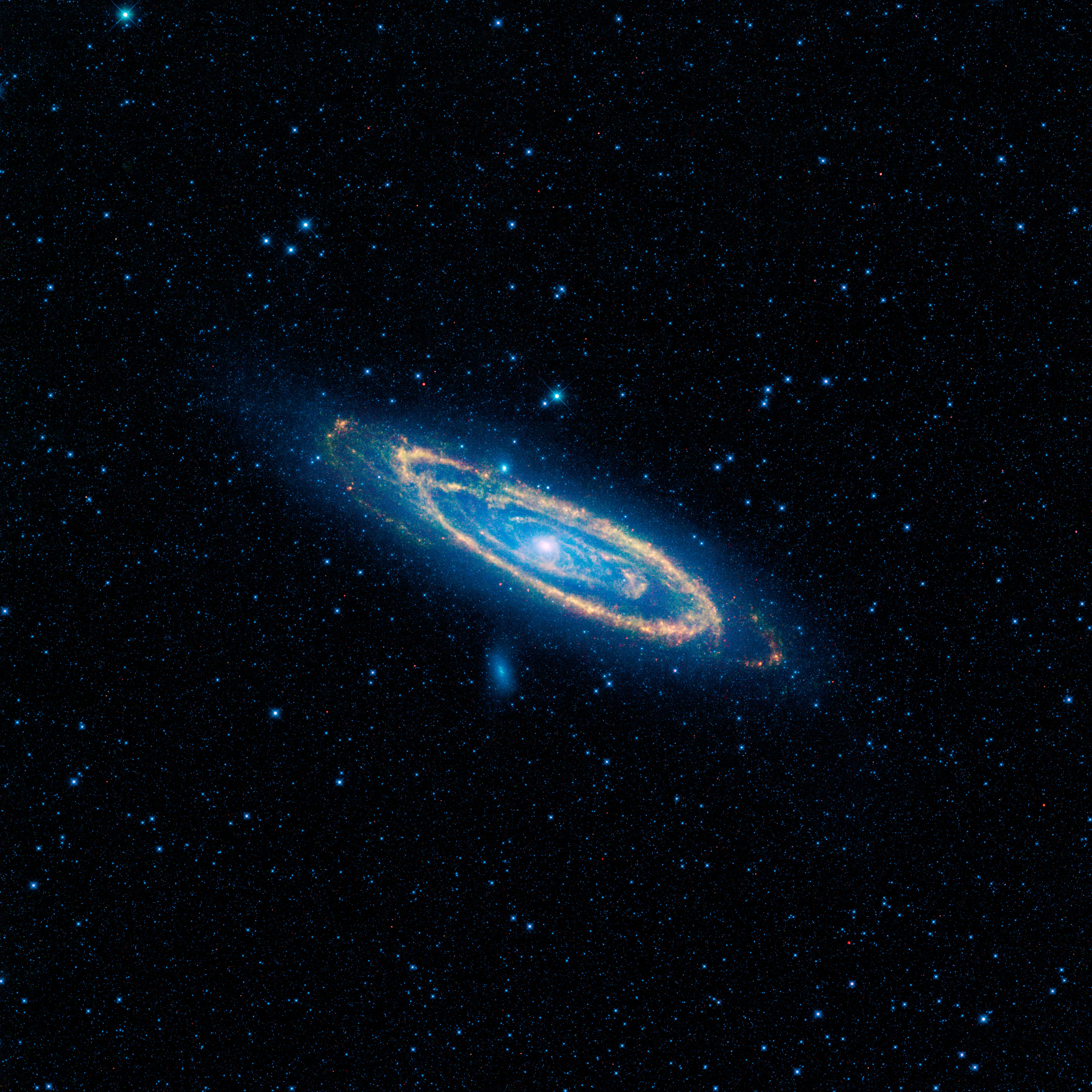
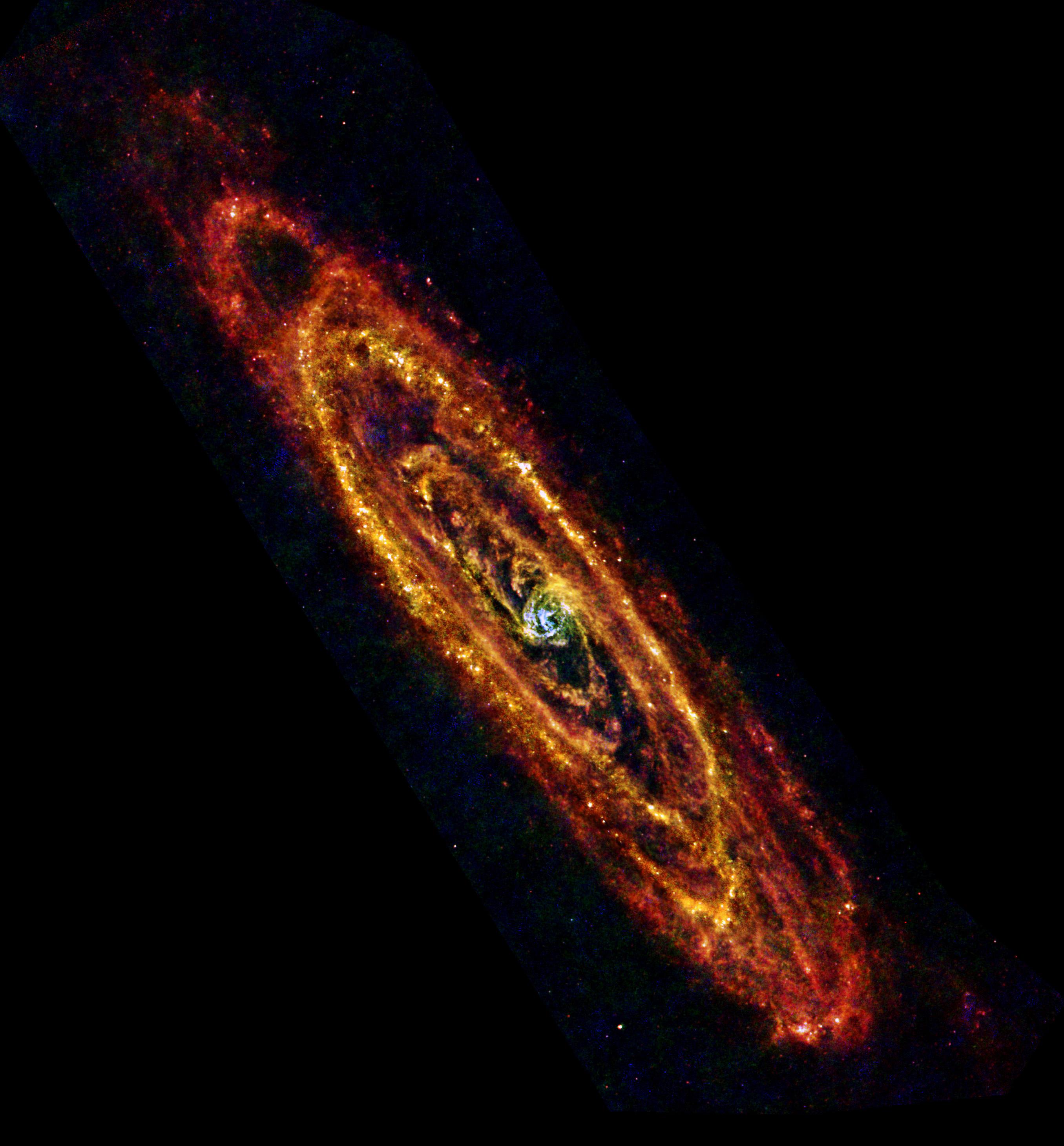
Infrared Wide View (WISE)
NASA's WISE survey captured Andromeda edge to edge in infrared light — warm dust tracing the spiral arms across more than three degrees of sky.
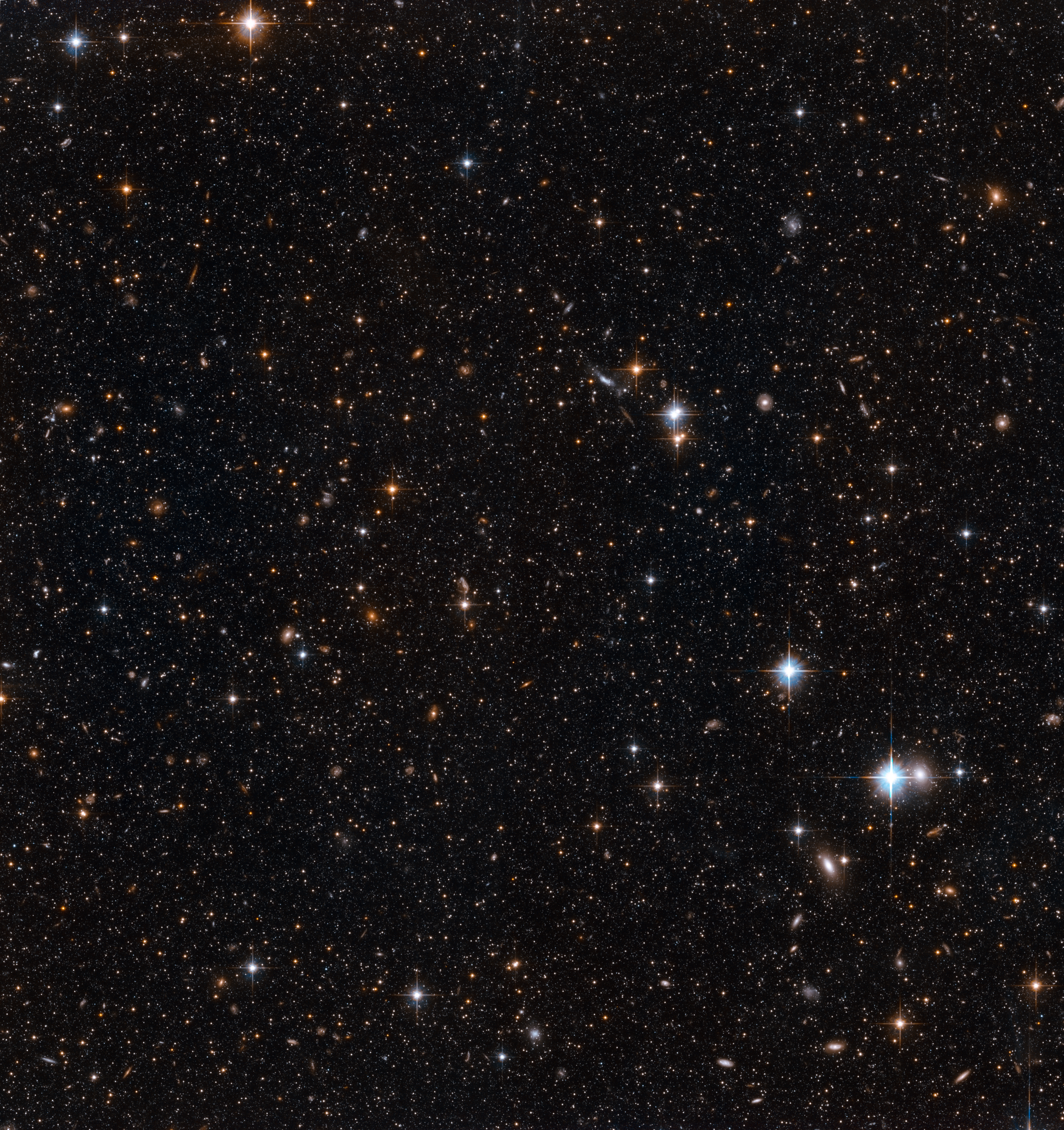
Hubble — Stars of the Disc
Hubble resolves the edge of M31's disc into individual stars — from Sun-like main-sequence stars to bright RR Lyrae variables used to gauge the galaxy's chemistry and age.
The debate that defined modern astronomy
For centuries, Andromeda was recorded as a "nebula" — a fuzzy patch of light. It first appears in writing from Persian astronomer Abd al-Rahman al-Sufi in 964 AD, who called it a "small cloud." For hundreds of years astronomers observed it, classified it, and disagreed about what it was.
In 1920, one of astronomy's most famous arguments played out publicly: the Great Debate between Harlow Shapley and Heber Curtis. Shapley argued the Milky Way was enormous and that spiral nebulae like M31 were clouds inside it. Curtis argued the opposite — that the spirals were "island universes," entirely separate galaxies far beyond our own. Both sides had supporting evidence. Neither could prove the point conclusively.
Edwin Hubble settled it in 1925. By identifying Cepheid variable stars in Andromeda — stars whose brightness cycles reveal their true distance — he calculated that M31 was roughly 900,000 light-years away (later refined to 2.5 million). The spiral nebulae were not inside the Milky Way. They were galaxies. That single observation fundamentally changed our picture of the universe.
One of the best naked-eye targets in autumn
Andromeda is worth finding because it rewards you with a real sense of scale. Even without a telescope, you are looking at a trillion stars 2.5 million light-years away. The photons hitting your retina left M31 before modern humans existed on Earth.
Under a suburban sky, the core looks like a faint cotton smudge slightly elongated to the northeast. Under a darker sky, the oval shape becomes obvious and the extent grows. Binoculars reveal the shape more clearly and, from a dark site, a hint of the galaxy's outer arms. A telescope on low power can show the bright core well, but the very best view of Andromeda is often with the naked eye or wide binoculars, because high magnification cuts off the sense of scale.
Finder trick
Start at the Great Square of Pegasus. Find Alpheratz at the northeast corner, follow the arc of stars in Andromeda two hops toward Cassiopeia, and look about 15° north — the smudge appears between the two chains.
Binoculars
Wide-field binoculars show the elongated halo and make M31 feel like an object with real extent. Also look for M32 (compact satellite) just south of center.
Dark skies matter most
Unlike most deep-sky objects that respond to larger aperture, Andromeda rewards a darker sky above all. Its surface brightness is low and spread wide — aperture alone does not help much.
New to stargazing? See how to observe the night sky, and if you're choosing gear, the no-hype telescope buying guide.
A trillion stars, an unusual nucleus, and a coming merger
M31 contains roughly a trillion stars — about twice as many as the Milky Way by most estimates. It has its own retinue of satellite galaxies, with M32 and M110 the easiest to spot. M32 is a compact elliptical that has likely had the outer portions of its disk stripped away by close interactions with M31; M110 is a more diffuse dwarf elliptical.
Andromeda's nucleus is one of the more unusual galactic cores known. Hubble imaging revealed a double-nucleus structure: two brightness peaks separated by only a few light-years. The leading explanation is that the secondary peak is an off-center ring of older stars orbiting the central black hole, which is estimated at roughly 100 million solar masses — considerably more massive than the Milky Way's own Sagittarius A*, which sits at around 4 million solar masses.
Andromeda is approaching us at roughly 110 kilometers per second, and for years a future merger with the Milky Way was treated as a certainty — the fabled "Milkomeda." But that has recently been overturned: in 2025, astronomers using precise Gaia and Hubble measurements found only about a 50% chance of a merger within the next 10 billion years, and just a 2% chance of the classic head-on collision in 4–5 billion years. The fate of our two galaxies is once again an open question — the full story is on the galaxy collisions page.
Andromeda sits at the heart of this site's Galaxies section — it's the nearest great galaxy, the one our own Milky Way may or may not one day meet, and the very galaxy Edwin Hubble used to prove that a universe of galaxies exists beyond our own.
Finding the Andromeda Galaxy in the fall sky
Andromeda is highest in the sky during September, October, and November from the Northern Hemisphere. The easiest path is from the Great Square of Pegasus: identify Alpheratz at the northeastern corner, follow the two chains of stars that form the constellation Andromeda, and look for the smudge offset above that line near the star Mirach. Apps like Stellarium or Sky Map make the star-hop trivially easy if this is your first time finding it.
Best setup
Naked eye or binoculars on a dark, moonless night. A telescope on low power (25mm or wider eyepiece) shows the core beautifully. High magnification zooms too far in to appreciate the galaxy's full spread.
Best season
September through November, with October typically offering the best compromise of darkness, temperature, and sky height from Minnesota and the Northern Hemisphere mid-latitudes.
Primary sources: ESA/Hubble PHAT panoramic of M31, NASA GALEX ultraviolet image of M31, NASA Messier 31 guide, and Britannica Andromeda Galaxy reference.
The myth behind the name
Long before it was known to hold a galaxy, Andromeda was a princess. She was the daughter of King Cepheus and Queen Cassiopeia of Aethiopia. When Cassiopeia boasted that they outshone the sea nymphs, Poseidon sent the monster Cetus to ravage the coast, and an oracle declared that only the sacrifice of Andromeda would satisfy the god. Her own parents chained her to a rock at the water's edge to await the beast.
The hero Perseus was flying home from killing Medusa when he saw her. He struck down the monster, broke her chains, and married her. The gods set the whole family in the autumn sky, and Andromeda still hangs there as a chain of stars between Pegasus and Perseus. One of those stars, Alpheratz, is shared with the Great Square of Pegasus, so the princess is forever joined at the head to the winged horse. This is the constellation that carries the great galaxy above.
Part of the Royal Family
Andromeda belongs to the connected autumn saga of the Royal Family, mapped on the Greek mythology hub.
Cassiopeia · Cepheus · Andromeda · Perseus · Pegasus · Cetus
Andromeda's light set out before our species had a name and arrives tonight as a faint grey oval — an entire galaxy drifting slowly toward us, that our distant descendants will one day watch fill the whole sky.
More astronomy notes
Continue through the astronomy section for beginner-friendly notes, image credits, viewing tips, history, and the stories behind the night sky.
Astronomy · Orion Nebula · Hercules Cluster · Ring Nebula · Interests